|
INDEX |
|
| FAMOUS PEOPLE | |
| > Fidèl Castro | |
| > Chè Guevara | |
| > Camilo Cienfuegos | |
| > Ernest Hemingway | |
| > Hatuey | |
| > Others | |
|
| FAMOUS
PEOPLE |
|
Fidèl castro |
Fidèl castro
|
Fidel Alejandro Castro Ruz was born on August 1926; son of a rich land-owner, he married the daughter of one of the richest man in Cuba and could have led a very reach and relaxed life. The rebel soul of the young Castro showed-up since the University years, at the Law college and as a member of the Partido Ortodoxo, a social-democratic party. His first guerrilla action against the Batista dictatorship (backed by the US and by the mafia mobsters who where the real bosses in Cuba) dates back to the 26th of July, 1943, when he tried to assault the Moncada Army Barracks with a handful of men. The attempt ended into a bloodbath for Castro's rebels and he was sentenced to 15 years. During his defense speech he pronounced the phrase considered, still today, his political testament: "History will absolve me". After 2 years, a general amnesty conceded by Batista to celebrate his re-election, took hi out of the prison; he traveled through the US and Mexico to raise funds for his movement that would have led to Cuba's freedom. And in Mexico he met a young Argentinean doctor, Ernesto Che Guevara, who will be a co-founder of the 26th of July movement for Cuba's liberation. Together with his brother Raùl, Che Guevara, Camilo Cienfuegos and many others, left the coasts of Mexico in December 1956 aboard the yacht Granma, to lead the final offensive that resulted, in 1959, into Batista's exile and in the conquer of power by the Barbudos, nickname given by the people to the revolutionaries. The movement led by Castro had a strong equalitarian connotation and was supported by the church at the beginning; when Castro nationalized all the industries in Cuba in the 60s, the Marxist face of the Revolution showed-up, and was the beginning of exile for many Cubans. The economic laws against Cuba, together with the many attempts to assassin the Lidér and the Pig's bay invasion, pushed Castro into the arms of the Soviet Union and anti-imperialism became the spine of the Cuban politics. All this led to the missile crisis in 1962, maybe the nearest point to the third world war. With the money received by the URSS Castro could start some reforms, like ensuring a house, free instruction and free health care for all Cuban citizens. Castro also supported other revolutionary movements in other parts of the world, like Angola and Ethiopia, and has been the President of the Conference of the non-aligned Countries. The fall of communism and the embargo (still present nowadays) has brought Cuba on the border of a deep economical crisis; today tourism is considered to be national priority to back the fragile economy of the Country. |
|
|
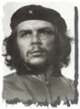
Ernesto Chè Guevara |
Chè Guevara
|
Ernesto Guevara was born in Rosario, Argentina, in 1928 and in 1945 had moved to Buenos Aires with his family, starting his studies in medicine. During his youth he traveled extensively South and Centre America, experiencing the extreme poor life conditions of the populations, the social injustice, racial discrimination towards the Indios; these experiences convinced him that his mission in life was more important than medicine. In 1953 was in Guatemala, where a democratically elected government was making popular social reforms was overthrown by a coup backed by the CIA, putting-up a military dictatorship that lasted 45 years; Guevara was deported to Mexico and here he met the young Cuban Raul Castro, Fidèl's brother. After the passionate speech of Raul Castro about Cuba's freedom and a meeting with Fidèl, he decided to join the 26th of July group which boarded the Granma to free Cuba. The Cubans nicknamed him ché (always with a small c), a typical Argentinian expression that means: "hey, you". Guevara played an essential role in the "conversion" of Castro to Marxism, being himself grown-up reading Marx, Engels and Mao Tze-Tung. Once landed in Cuba, he hide on the Sierra Maestra to escape ambushes from Batista army and, in 1957, he became commander of nearly 700 men. His troops acted, together with the ones of Camilo Cienfuegos, in the zone of Santa Clara and Camaguey, cutting the island in two, breaking the front of Batista's governmental troops. Charismatic commander, even during the hardest times he was able to encourage his troops, leading him to march triumphant, together with Cienfuegos, in la Habana on the 2nd of Janaury, 1959; the following month he received the Cuban Citizenship. He covered different positions in the Cuban Government, from Head of the Department for Agricultural Reforms, to President of the National Bank, to Ministry of Industry, starting many social reforms. His frequent travels to Europe, Africa and Asia, made stronger his belief that only the Revolution could free people from poverty and social differences. His rebel soul could not stand the easy life he deserved in Cuba for leading the Revolution to success, so he left for Africa in 1965, where he fought in Congo and Angola, and then to Bolivia. His presence in Bolivia scared the US government, that sent troops to help the Bolivian President, target of the revolutionary soldiers; he was caught during an ambush and killed under the witness eye of American officers on the 9th of October, 1967. His body, found 30 years later, were transported to Cuba the year after, where State funerals where held for a Nation's hero. His body rests in the Ché Guevara Mausoleum in S.ta Clara. To better understand his soul and his ideas, here are two extract from
his speech: |
|
|
Camilo Cienfuegos |
Camilo Cienfuegos
|
Born from a low-class family and son of an anarchist, Camilo was forced to leave school and work as a tailor; at the age of 23, during a students' parade, was wounded by the troops of Batista and that episode convinced him that the right path to follow was the one of Fidèl. Big friend of Fidèl and Raùl Castro, in the beginning of the 50s he committed himself in fund-raising for the anti Batista movement, travelling often to the US and to Mexico; he was part of the expedition of the Granma, that left Mexico towards Cuba to free the island from the dictator backed by the US. During his revolutionary career, from undisciplined soldier he became a valuable Commander, head of nearly 700 men acting mainly around Camaguey and the northern part of las Villas, while Che Guevara was proceeding in the southern zone of the province. After the Barbudos gained power, Cienfuegos became Military Chief of la Habana, and then Commander in Chief of the Cuban Army. During his life his popularity was comparable to the one of Castro, and still nowadays he's an icon of the Revolution; for his social extraction and for the love he received from the people, Che Guevara described him as the "image of the people". But a there was a difference between the two: Cienfuegos was not a communist. The 28th of October 1959, returning from Camaguey, his Cessna plane fell and sank in the Caribbean sea, but was never found, in spite of the extensive search that saw Castro himself guiding rescue teams. Every year, for the anniversary of his disappear, school children throw flowers in the sea to remember his death. |
|
|
Ernest Hemingway |
Ernest Hemingway
|
Born close to Chicago, Ernest Hemingway left very soon his birth-place, considered very provincial by him, and started to travel in search of a place suitable for his soul (and maybe to escape from his mother's maney requests). At the age of 22 he married Elizabeth Hadley Richardson, and moved to Paris where he started his career as a journalist and as a writer. Even if deeply in love with Elizabeth, he had an affair with journalist Pauline Pfeiffer (who later became the second Mrs Hemingway) and divorced. With Pauline he moved to Key West, an almost unknown spot at the time, but very popular among intellectuals, and Hemingway liked a lot its relaxed atmosphere. He could count on the economic support of Pauline's family and had a second and third son from Pauline (after the first from Elizabeth Hadley). He was a regular at the Sloppy Joe's bar and attended many fishing-games; during one of this in the habana bay (that lasted 4 months instead of 2 days) he fell in love with the island. He first moved to the Ambos Mundos Hotel and started a relation with journalist-writer Martha Gellhorn and moved to Spain with her, correspondents fro the Spanish Civil War. After their return to Cuba Martha bought the Finca Vigia, a farm where the new married couple moved in 1940. Even if Cuba, in those years, was renowed for being the "brothel of America", hemigway liked the idea of living in shorts and t-shirt and was deeply in love with the fishing-hunts for the blue marlin on his boat, the Pilar. This kind of life was not really the best for Martha, a very ambitious writer and journalist, so she went to Europe to report aout the Second World War as a journalist. Also Hemingway couldn't say no to his newspaper to go London and there he met Mary Welsh, another journalist, who became the fourth Mrs Hemingway. When they returned to Cuba, they witnessed the gain of power by the Barbudos, but he didn't leave the island together with the other americans, but, instead, he made his best whishes to the Comandante, whishes appreciated by Castro. The old man and the sea, the novel that gave him the Nobel prize, was inspired by the life of Gregorio Fuentes (who died in 2001) a fisherman from the small village of Cojimar, where Hemingway used to keep his boat. The posthuomus novel Islands in the tide is a series of novel inspired by his Habana stay; the book is a declaration of his love for Cuba: he describes the cocks fights, the hunting games, the cool mornings in La Finca and the fishing-games in the Gulf that he used to call the Blu River. Hemingway left Cuba in 1960, leaving the Finca Vigia to the Cuban people; today, together with the boat Pilar, is the Hemingway Museum. He committed suicide the year after, in Idhao. |
|
|
Hatuey |
Hatuey
|
In 1511 the Spanish conqueror Diego Velasquez reached the island of Cuba, after having conquered the ear island of Hispaniola, the modern Haiti and S.to Domingo. Hatuey, a Cacique of the Tainòs tribe in Hispaniola, testified this massacre and fled, with a group of men, to Cuba, to escape the Spanish prosecutions. Here he warned the local tribes and convinced them to get rid of the gold they had, considered to be the real God of the Spanish; he also organized a first form of resistance to the invaders, based on quick attacks and quick escapes. With the help of a betrayer, Velasquez caught him and burned him alive. Legend says that Hatuey was already tied to a wooden pole when a Spanish priest, Bartlomè de las Casas, tried to convert him to Christianity, offering him Baptism and the road to Paradise. Hatuay replied that if also baptized Spanish went to Paradise, then he would have preferred to go to Hell. This legend is very popular especially in the Oriente provinces; it is still believed nowadays that in Yara, the place wher Hatuey was burned on the 2nd of February 1512, he shows in the form of a light, the Luz de Yara. For his rebellion against the Spanish and for his fighting techniques, very similar to the Guerrilla ones, Hatuey is considered to be el primero, the first Cuban hero. A curiosity, even if the Cacique wouldn't have liked it: a brewery in Santiago produces a beer brand in memory of Hatuey: the Cerveza Hatuey, also cited by Hemingway in his Old man and the sea. Maybe you'll have the chance to taste it during your next vacation in Cuba. |
|
|
Other famous-ones |
Raul Castro |
Raul
Castro |
|
Fulgencio Batista |
Fulgencio
Batista |
|
Carlos Manuel de Cespedes |
Carlos Manuel
de Cespedes |
|
Antonio Maceo |
Antonio
Maceo |
|
Maximo Gomez |
Maximo Gomez |
|
Josè Martì |
Josè
Martì |